
Multi-State Compliance: Navigating the Maze of Workplace Mandates
If you’re managing employees across multiple states, you’ve likely experienced that sinking feeling when you realize each jurisdiction has its own rules. What works in California might violate laws in Texas. Your New York handbook might be useless in Florida. And federal regulations? They’re just the baseline—many states have gone far beyond them.
The challenge of juggling federal, state, and local laws becomes even more daunting in critical areas like harassment prevention training, paid leave policies, and mandatory workplace education. One missed requirement can lead to costly fines, damaging audits, or reputation-crushing lawsuits.
This guide is designed to help HR leaders and employers understand how to maintain compliance while operating across state lines—without losing your sanity in the process.
Why Multi-State Compliance Is a Growing Concern

The landscape of American work has fundamentally changed. Remote work isn’t just a pandemic-era trend—it’s become the new normal for millions of workers. Companies that once operated from a single headquarters now manage decentralized teams spanning multiple time zones and legal jurisdictions.
Post-Pandemic Trends with Remote Employees in the U.S.
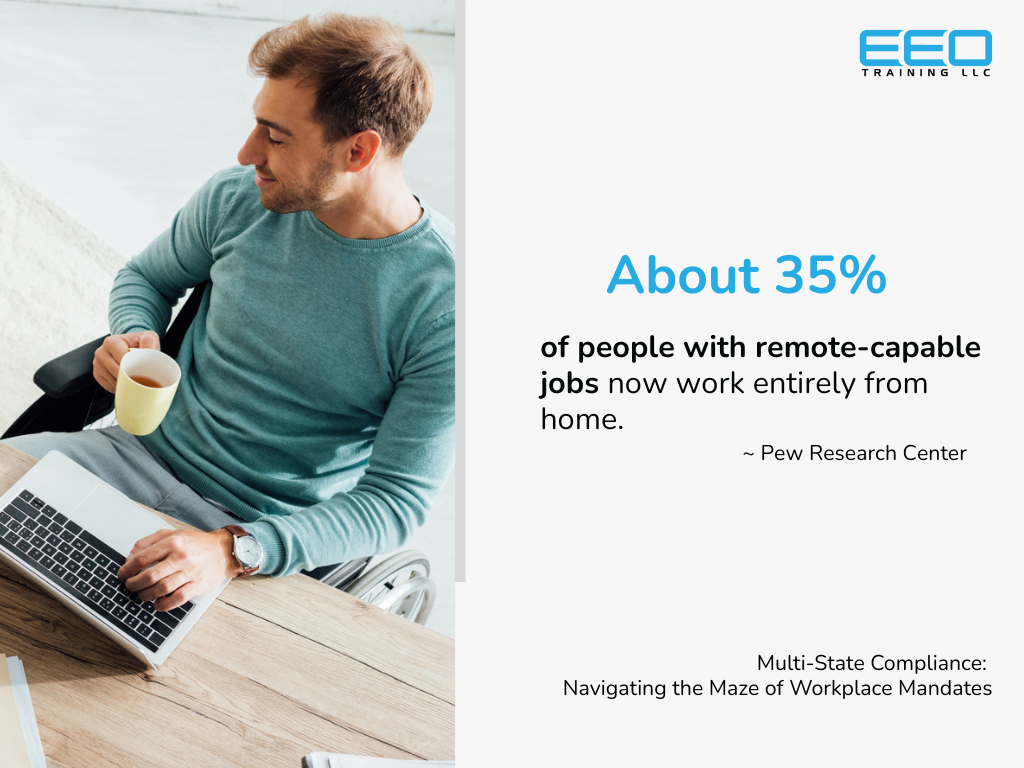
According to Pew Research Center data on remote work trends, the shift to multi-state operations has accelerated dramatically. About a third (35%) of workers with jobs that can be done remotely are now working from home all the time, and many organizations are now employing workers in states where they never imagined having a physical presence.
Here’s the problem: legal complexity doesn’t just add up—it multiplies with each new jurisdiction. Every state you operate in brings its own:
- Reporting requirements
- Training mandates
- Leave policies
- Wage and hour rules
- Anti-discrimination protections
The real-world risks are severe. Companies face lawsuits from employees who weren’t provided the legally required training. State labor departments conduct audits that reveal policy gaps. Fines stack up quickly. And in today’s transparent digital age, compliance failures can severely damage your brand reputation and make it harder to attract top talent.
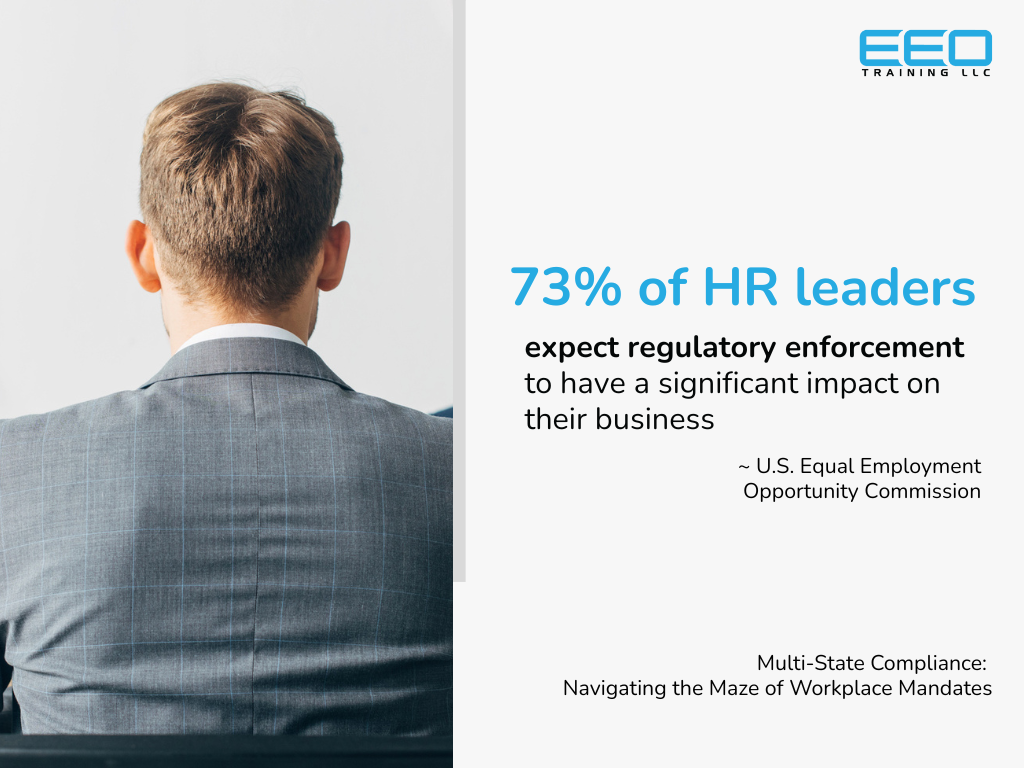
Data from the U.S. Equal Employment Opportunity Commission (EEOC) on the laws they enforce shows that discrimination and harassment violations continue to be significant areas of litigation, with multi-state employers particularly vulnerable when they fail to meet state-specific requirements. Littler Mendelson’s Annual Employer Survey consistently identifies multi-jurisdiction compliance as one of the top concerns for HR leaders nationwide, with 73% of executives expecting regulatory enforcement to have a moderate or significant impact on their business.
Understanding what you need to do is one thing—actually doing it is another. Here are the day-to-day challenges employers face:

Constant Legal Changes
Laws don’t stay static. New legislation passes regularly, court decisions create new interpretations, and agency guidance evolves.
Resolution Advice: Subscribe to state-specific legal alerts, join employer associations in key states, and consider retaining counsel in jurisdictions where you have significant operations.
Lack of Internal Expertise or Bandwidth
Small to mid-sized companies often lack dedicated compliance staff who can interpret complex regulations across multiple jurisdictions.
Resolution Advice: Outsource what you can’t handle internally. Compliance training, policy development, and ongoing monitoring can often be managed more efficiently through specialized providers than by trying to build all expertise in-house.
Remote Workforce Confusion (Where Are Your Workers “Based”?)
When an employee lives in one state, works remotely for a company headquartered in another, and occasionally travels to a third state, which laws apply?
Resolution Advice: Generally, the laws of the state where the employee performs work apply. Develop clear guidelines for determining worker location and ensure your HR systems accurately track this information.
Complex Reporting Requirements from Multiple Agencies
Federal, state, and sometimes local agencies each want their data, often in different formats and on different schedules.
Resolution Advice: Create a centralized compliance calendar with all reporting deadlines. Assign ownership for each requirement and build in buffer time before actual due dates.
Employee Misunderstandings of Their Rights by Location
Employees often don’t know which protections apply to them, leading to confusion or perceived inequality among workers in different states.
Resolution Advice: Provide clear, accessible information about state-specific rights and benefits. Consider creating location-specific FAQ documents or resources that employees can reference.
Core Areas of Workplace Compliance That Vary by State

Understanding where states diverge is the first step toward building a compliant framework. Let’s break down the most commonly varying mandates:
Anti-Harassment Training Requirements
This is where state differences become immediately apparent. California’s SB 1343 requires harassment prevention training for all employers with five or more employees, with specific time requirements and content mandates. Illinois: The Workplace Transparency Act mandates annual sexual harassment prevention training for all employees in every workplace. New York mandates interactive training for all employees on an annual basis.
Meanwhile, many other states have no mandatory harassment training requirements at all—though that doesn’t mean employers shouldn’t provide it.
Paid Leave Laws (Sick Leave, Family Leave, etc.)
While the federal Family and Medical Leave Act (FMLA) provides unpaid leave, states have added their own layers. California’s Paid Family Leave program offers wage replacement during qualifying leave periods—something FMLA doesn’t provide. Washington, Massachusetts, and several other states have implemented their own paid family and medical leave programs, each with unique contribution requirements, benefit levels, and qualifying conditions.
EEO Reporting Requirements
While federal contractors must comply with specific EEOC reporting requirements, various states impose additional data requests and reporting obligations. Some states require more granular demographic data, while others mandate submission to state-level civil rights agencies in addition to federal filings.
Wage and Hour Laws
Minimum wage varies dramatically by state—and even by city in some cases. Some states mandate daily overtime (not just weekly), specific meal and rest break schedules, and unique rules about final paycheck timing. California’s wage and hour laws are notoriously complex, while states like Alabama follow federal guidelines more closely.
Disability and Accommodation Guidelines
The federal Americans with Disabilities Act (ADA) sets a floor, but states like California have enacted broader protections through the Fair Employment and Housing Act (FEHA). These state laws may cover smaller employers, define disability more expansively, or require additional interactive process steps.
Tax Regulations
Multi-state employment creates a web of tax obligations that extends far beyond simple payroll withholding. When you have employees working across state lines, you’re dealing with multiple tax jurisdictions simultaneously—each with its own rules, rates, and reporting requirements.
Foundational Strategies to Stay Compliant Across Jurisdictions

Managing multi-state compliance requires strategic thinking and systematic processes. Here are the essential steps:
Conduct a State-by-State Policy Audit
Start by identifying exactly which states you have employees in—including fully remote workers. Then audit your current policies against each state’s requirements. The SHRM State & Local Updates resource provides comprehensive comparisons of state employment laws to help you identify gaps.
Centralize Documentation and Local Employment Law Compliance
Maintain a central repository of policies, but create state-specific addenda or supplements. Your core harassment prevention policy can be consistent, but training delivery, frequency, and content may need to vary by location.
Use Compliance Software or Legal Databases
Manual tracking becomes impossible as you scale. Platforms like EEO Training help automate training, reporting, and tracking across states. These compliance management software solutions can be invaluable for maintaining audit-ready documentation, with features designed to handle multi-state complexity.
Regular Training and Updates for HR Teams
Your HR team needs ongoing education about changing requirements. Subscribe to legal updates, attend webinars, and ensure someone owns compliance monitoring for each jurisdiction where you operate. The U.S. Department of Labor (DOL) Wage and Hour Division’s Compliance Assistance resources offer helpful guidance and tools.
Partner with EEO Training Providers Familiar with Multi-State Needs
Working with providers who understand multi-state complexity can save enormous time and reduce risk. The EEOC Training Institute offers compliant training programs, and specialized providers like EEOTraining.com deliver certification programs and harassment prevention training designed to meet varying state mandates while maintaining consistent quality across your organization.
Penalties for Non-Compliance

The financial and reputational costs of non-compliance can be devastating for employers operating across multiple states. Understanding potential penalties isn’t meant to create fear—it’s about recognizing the serious consequences so you can prevent them.
Federal Penalties
EEOC Violations: The Equal Employment Opportunity Commission can impose substantial penalties for discrimination and harassment violations:
- Compensatory damages for victims (back pay, emotional distress, medical costs)
- Punitive damages in cases of intentional discrimination
- Maximum combined damages ranging from $50,000 (for employers with 15-100 employees) to $300,000 (for employers with 500+ employees) per violation
- Legal fees and litigation costs often exceed the direct penalties
FLSA Wage and Hour Violations: The Fair Labor Standards Act violations carry serious consequences:
- Back wages owed to affected employees (can extend back 2-3 years)
- Liquidated damages equal to back wages in willful violation cases (essentially doubling the amount owed)
- Civil penalties up to $2,014 per violation for repeated or willful violations
- Criminal penalties, including fines up to $10,000 and imprisonment for willful violations
FMLA Penalties: Violations of the Family and Medical Leave Act result in:
- Damages equal to wages, benefits, and other compensation denied or lost
- Liquidated damages equal to the amount above (doubling the liability)
- Civil penalties up to $178 per violation for failing to post required notices
State-Specific Penalties
State penalties often exceed federal ones, particularly in employee-friendly jurisdictions:
California’s Aggressive Enforcement:
- Wage and Hour: Private Attorneys General Act (PAGA) allows employees to sue on behalf of the state, with penalties of $100 per employee per pay period for initial violations, $200 for subsequent violations
- Harassment Training: Failure to provide required training can result in liability in subsequent harassment claims, with courts viewing non-compliance as evidence of negligence
- Meal and Rest Break Violations: One hour of pay at the employee’s regular rate for each day a break is not provided (can add up to thousands per employee annually)
New York Penalties:
- Sexual Harassment Training: Failure to provide required annual training exposes employers to enhanced liability in harassment lawsuits and potential penalties from the State Division of Human Rights
- Wage Theft: Liquidated damages equal to 100% of underpaid wages, plus interest
- Freelance Isn’t Free Act: Double damages for non-payment of freelancers, plus attorney’s fees
Illinois Enforcement:
- Workplace Transparency Act Violations: Failure to provide required sexual harassment training can result in penalties of $1,000-$5,000 per violation during state investigations
- Day and Temporary Labor Services Act: Penalties of $500-$2,500 per violation for each affected worker
Massachusetts Penalties:
- Earned Sick Time: Penalties up to $25,000 and/or imprisonment for up to one year for retaliation
- Wage and Hour: Triple damages for wage violations, plus attorney’s fees
Common Mistakes to Avoid in Multi-State Compliance

Even well-intentioned employers make these critical errors:
Applying One State’s Laws Across All Offices
The Mistake: Using your headquarters state’s policies everywhere because “it’s the strictest, so we’re covered.”
What to Do Instead: While this might work sometimes, it can create unnecessary burdens in some states while still missing requirements in others. Each state deserves individual analysis.
Using Outdated Policies Not Reviewed Annually
The Mistake: Setting policies once and forgetting them while laws evolve rapidly.
What to Do Instead: Schedule annual policy reviews tied to your fiscal year. Employment law changes constantly—California alone often passes multiple new workplace laws each legislative session.
Failing to Localize Anti-Harassment or Wage Documentation
The Mistake: Distributing generic handbooks that don’t reference state-specific rights, processes, or contact information.
What to Do Instead: Create state-specific handbook sections or addenda that employees in each jurisdiction receive. Include relevant state agency contact information and procedures.
Inconsistent Training Frequency by Location
The Mistake: Training everyone at once company-wide without considering different state requirements for frequency and refresher training.
What to Do Instead: Build a training calendar that tracks state-specific requirements and automatically enrolls employees based on their work location.
Consider the story of a software company that grew from 50 employees in a single California office to 200 employees across six states in just 12 months. The explosive growth brought opportunity—and compliance chaos.
The Challenge
The company initially tried to apply California’s robust policies everywhere, assuming they would provide adequate protection. They quickly discovered problems:
- Illinois employees weren’t receiving the annual harassment prevention training that state law required
- Colorado employees hadn’t been informed about the state’s paid sick leave law
- The company was unprepared for New York’s specific harassment training content requirements
- Their payroll system wasn’t configured for multiple states’ wage and hour rules
The Wake-Up Call
During a routine state audit in Illinois, inspectors identified multiple training gaps and outdated policy acknowledgments. The potential fines were substantial, but more concerning was the realization that similar issues likely existed in their other expansion states.
The Solution
The company took decisive action:
Conducted a Comprehensive Audit: They partnered with employment counsel in each state to identify all location-specific requirements
Implemented Technology Solutions: They adopted compliance management software to track training by jurisdiction and automate state-specific assignments.
Partnered with EEOTraining.com: Rather than trying to develop six different training programs internally, they worked with a provider experienced in multi-state compliance to deliver consistent, high-quality training that met each jurisdiction’s specific requirements
Created State-Specific Documentation: They developed handbook addendums for each state and ensured new hires received appropriate location-specific information.
Established Ongoing Monitoring: They assigned a compliance owner who received regular updates from SHRM’s legal compliance resources and maintained a central calendar of all obligations.
The Results
Within six months, the company achieved audit-readiness across all locations. Employee satisfaction scores improved as workers felt more informed about their rights and protections. Most importantly, when the company expanded into three additional states the following year, they had systems in place to ensure compliance from day one.
Conclusion
Multi-state compliance is undeniably complex, but it’s far from impossible. The key is recognizing that complexity early and building systems to manage it proactively rather than reactively.
The employers who succeed in this environment share common characteristics: they conduct regular audits, localize policies while maintaining core consistency, leverage technology and expert partners, and view compliance not as a burden but as a foundation for sustainable growth.
As your organization expands across state lines—whether through remote hiring, new offices, or acquisitions—make compliance a strategic priority from the start. The investment in proper systems, training, and expertise pays dividends in reduced legal risk, stronger employee trust, and the confidence to grow without fear.

Ready to strengthen your multi-state compliance program? Explore comprehensive EEO compliance training solutions at EEOTraining.com that work across state lines. With the right approach and partners, you can navigate the compliance maze successfully—and focus your energy on building a great business rather than worrying about the next audit.
Tools & Resources for Managing Multi-State Employment Law Compliance
You don’t have to navigate this alone. Here are valuable resources:
Federal Resources
- U.S. Department of Labor Wage and Hour Division Compliance Assistance: Comprehensive guidance on federal employment law obligations
- EEOC Laws and Guidance: Detailed information on federal anti-discrimination requirements
- EEOC Training Institute: Professional training programs for HR professionals and managers
Commercial Tools and Databases
- SHRM State Law Comparison Tool: Side-by-side comparison of state employment laws (available to SHRM members)
Training Solutions
- EEOTraining.com: Offers multi-state EEO certification programs, harassment prevention training, and ongoing support specifically designed for organizations operating across multiple jurisdictions. Their flexible delivery options and expertise in varying state mandates make them particularly valuable for national employers.
