
Why Understanding Workplace Violence Training Matters Now

Why Understanding Workplace Violence Training Requirements Matters Now
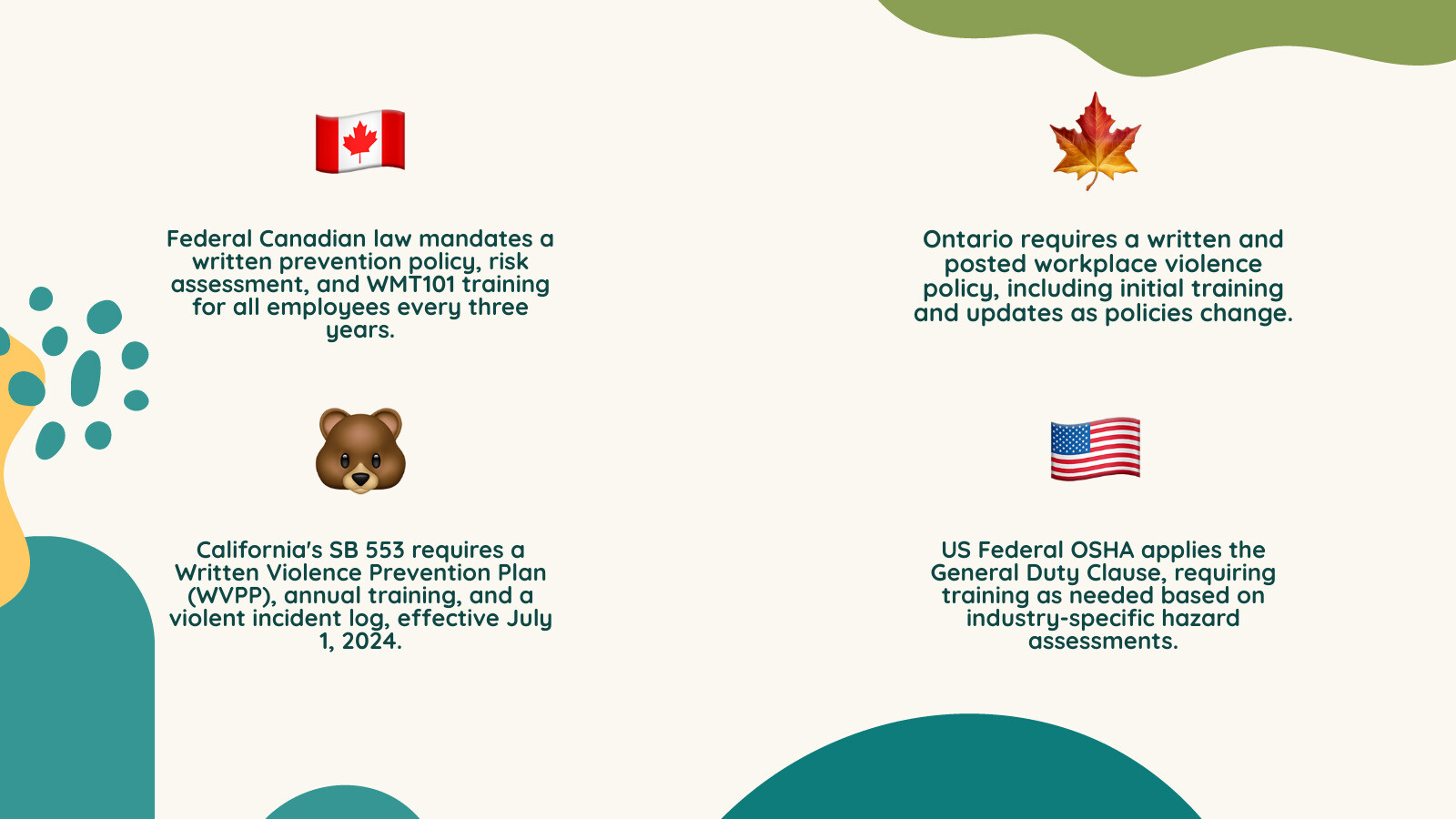
Workplace violence training requirements vary by location and industry, but all share the goal of protecting employees. Here’s a quick overview:
Quick Answer: Core Training Requirements
| Jurisdiction | Key Requirements | Training Frequency |
|---|---|---|
| Federal Canada | Written prevention policy, risk assessment, training for all employees (WMT101) | Within 3 months of hire, then every 3 years |
| Ontario | Written policy, training for all employees, posted workplace violence policy | Initial training + when policy changes |
| California (SB 553) | Written prevention plan (WVPP), annual training, violent incident log | Initial + annually (effective July 1, 2024) |
| US Federal (OSHA) | General Duty Clause applies; specific standards vary by industry | As needed based on hazard assessment |
Workplace violence is a pervasive issue. OSHA reports it affects nearly 2 million American workers annually, and dozens of Canadian workers die from it each year. These are not just statistics; they are preventable tragedies.
The legal landscape has shifted significantly. California’s SB 553 now requires most employers to have comprehensive prevention plans and annual training. In Canada, Bill C-65 mandates that federal employers develop prevention policies, assess risks, and train everyone.
The urgency is clear. Non-compliance is expensive, with penalties in California reaching up to $25,000 per violation. Beyond fines, organizations face reputational damage, low morale, and the profound cost of employee harm. Understanding your specific training obligations is a fundamental part of your duty as an employer.
Understanding Workplace Violence and Your Legal Obligations
Workplace violence and harassment are serious issues that impact everyone’s safety. Understanding what these behaviors are and what your legal responsibilities entail is the first step toward prevention.
What is Workplace Violence and What Are My Responsibilities?
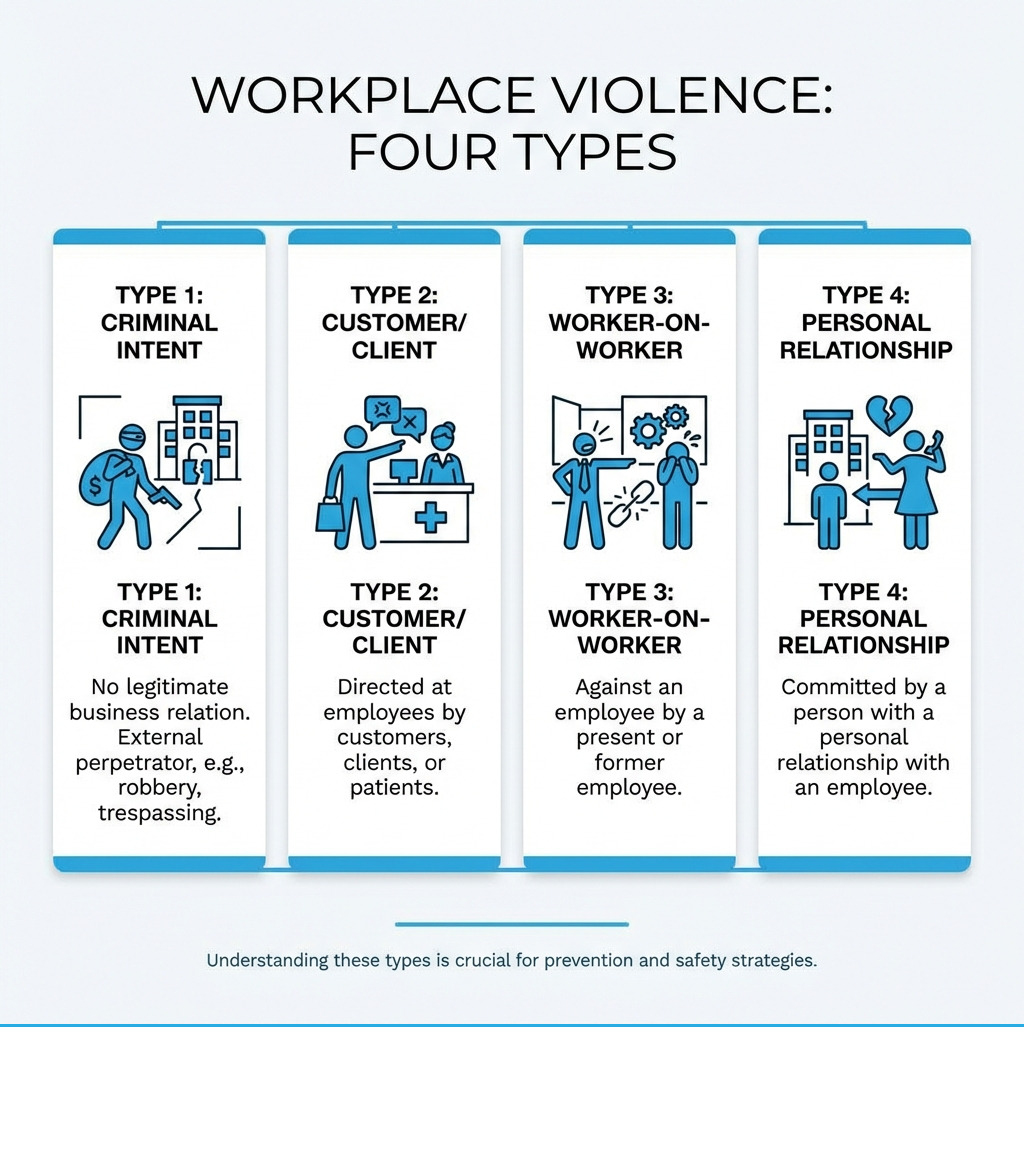
Workplace violence is any act or threat of violence, while workplace harassment is conduct that can cause offense or humiliation. These behaviors can range from verbal threats, intimidation, and bullying to physical assault and sexual harassment. It also includes cyberbullying and instances where domestic violence enters the workplace, which is a critical and often overlooked risk.
Preventing workplace violence is a shared responsibility:
- Employees must participate in training, report concerns, and help maintain a respectful culture.
- Supervisors are the first line of defense. They must recognize warning signs, respond to incidents, and ensure their teams follow prevention policies.
- Employers have the greatest legal obligation. They must develop a prevention policy, assess risks, provide training, establish clear reporting and investigation procedures, and support employees affected by incidents.
What Are the Legal Obligations for Employers in Canada and the United States?
The legal landscape for workplace violence prevention is complex, but the employer’s duty to provide a safe environment is universal.

United States Federal & State Regulations
In the US, the Occupational Safety and Health Administration (OSHA) uses the General Duty Clause to require employers to provide a workplace free from recognized hazards, including violence. While no single federal standard covers all industries, this clause is widely applied.
A major development is California’s Senate Bill 553 (SB 553). Effective July 1, 2024, it mandates that most California employers create a written Workplace Violence Prevention Plan (WVPP), conduct annual employee training, and log all violent incidents. This law represents a significant shift toward proactive prevention. For more details on requirements across the US, see our guide: More info about state-by-state compliance.
Canadian Federal & Provincial Regulations
Canada has a robust framework, especially at the federal level. Bill C-65 amended the Canada Labour Code, requiring federally regulated employers to develop a prevention policy, conduct risk assessments, train all employees, and establish a clear resolution process.
Provincial laws are also strict. In Ontario, the Occupational Health and Safety Act (OHSA) requires nearly all workplaces to have a written and posted policy and provide training to every employee. These legal obligations highlight the importance of understanding the specific workplace violence training requirements for your location and industry.
A Breakdown of Workplace Violence Training Requirements
Effective workplace violence training is about building a culture of safety, not just checking a box. Let’s break down the practical components of a compliant program.

What Are the Key Components of a Prevention Program?
A robust prevention program includes several interconnected parts:
- Written Policy: The foundation of your program, outlining your commitment, defining roles, and detailing procedures. This is often called a Workplace Violence Prevention Plan (WVPP) in California.
- Risk Assessment: A systematic process to identify and evaluate potential violence hazards specific to your workplace.
- Reporting Procedures: A clear, confidential, and non-retaliatory process for employees to report concerns.
- Investigation Process: A fair and timely method for investigating all reported incidents.
- Emergency Procedures: Protocols for responding to immediate threats, such as lockdowns or contacting law enforcement.
- Employee Support: Measures to help employees who have experienced or witnessed violence.
- Training: Comprehensive, ongoing training for all employees, which is a cornerstone of any effective program.
For more guidance, OSHA offers helpful resources on A guide to prevention programs.
What Are the Specific Topics for Workplace Violence Training Requirements?
Our training solutions use engaging video content to cover the essential topics required for compliance. Effective training should include:
- General Awareness: Defining workplace violence and harassment (WVH), understanding relevant laws (e.g., Canada Labour Code and SB 553), recognizing warning signs, and knowing prevention strategies.
- Procedures and Response: Clear instructions on how to report incidents, what to do in an emergency, and how to access support resources.
- Role-Specific Duties: Specialized training for managers and supervisors on implementing the plan, responding to reports, and supporting their teams. EEO Training LLC‘s workplace violence prevention training helps organizations cover these responsibilities with practical, compliance-focused instruction.
- Advanced Skills: Practical techniques for de-escalation, responding to incidents, and addressing site-specific hazards. Bystander intervention is another critical skill; learn more through our bystander intervention training.
Active Shooter Awareness training can complement a workplace violence prevention program by helping employees recognize active shooter situations, understand basic safety concepts and protocols, prepare for emergencies, and respond appropriately when law enforcement arrives. The course covers topics such as Run-Hide-Fight, scenario preparation, personal readiness, and practical dos and don’ts; it should support, not replace, an organization-specific workplace violence prevention plan.
How Often Must You Fulfill Workplace Violence Training Requirements?
Training is not a one-time event. Regulations specify ongoing requirements to ensure knowledge remains current.

- Initial Training: All new hires must be trained shortly after starting. In federal Canadian workplaces, this is within the first three months.
- Regular Refreshers: Training must be repeated periodically.
- Annually: California’s SB 553 mandates annual training.
- Every 3 Years: Federally regulated workplaces in Canada require retraining at least every three years.
- As Needed: Additional training is required whenever the prevention plan changes, new hazards are identified, or after an incident occurs.
Record-Keeping
Employers must maintain detailed training records to prove compliance. These logs should include training dates, content, and attendee information. Retention periods vary by jurisdiction; for example, California’s SB 553 requires training records to be kept for at least one year, while incident investigation records must be kept for five years.
Ensuring Compliance and Finding Help
Navigating the complexities of workplace violence training requirements is crucial. Beyond the moral duty to protect employees, non-compliance carries significant legal, financial, and reputational risks.
What Are the Consequences of Non-Compliance and Where Can I Find Resources?
Failing to comply with regulations can lead to severe outcomes:
- Fines and Penalties: Authorities can impose steep fines, such as the $18,000 to $25,000 per violation possible under California’s SB 553.
- Legal Action: Employers may face civil lawsuits from employees harmed in the workplace.
- Reputational Damage: A reputation for an unsafe workplace can harm recruitment, retention, and public trust.
- Decreased Morale and Productivity: An unsafe environment leads to higher absenteeism, increased turnover, and lower productivity.
EEO Training Solutions: Your Partner in Compliance
At EEO Training LLC, we specialize in online compliance training, including comprehensive violence prevention programs. Our innovative video content and learning management system make complex legal requirements understandable and engaging. We understand the nuances of jurisdictions from Canada to California and can help you build a compliant and effective program.
Ensuring compliance with workplace violence training requirements is a critical investment in your people and your organization’s future.
To learn more about how we can help you meet your obligations, please visit our dedicated page: Learn more about our Workplace Violence Training Requirements.
What Should Workplace Violence Prevention Training Cover?
EEO Training LLC‘s workplace violence prevention course objectives are designed to help employees recognize risks, respond appropriately, and apply the organization’s prevention procedures. A comprehensive program should cover:
- Defining workplace violence: Explain what workplace violence means and outline common types, behaviors, and examples.
- Recognizing risk factors and behaviors of concern: Help employees identify potential warning signs, higher-risk situations, and circumstances that may require early intervention.
- Preventing and reducing workplace violence: Address practical prevention measures, ways to reduce risk, and the role of organization-specific policies.
- Responding to an incident: Explain what to do if workplace violence occurs, including how to seek help, respond to injuries, and follow emergency procedures.
- Reporting concerns: Clarify how and when to report workplace violence-related concerns through the organization’s reporting process.
- Applying jurisdiction-specific requirements: Connect the training to applicable legal and regulatory obligations.
- Using practical scenarios: Use examples and hypotheticals to help learners apply the material to realistic workplace situations.
By combining core prevention concepts with workplace-specific policies and practical scenarios, organizations can give employees clearer direction before a concern escalates.
About Andrew Botwin Esq, AWI-CH, SPHR, SHRM-SCP, PCC, MBA: Andrew Botwin, co-founder of EEO Training LLC, brings experience in workplace investigations, HR, coaching, and compliance training. His practical perspective helps organizations translate workplace violence prevention requirements into clear training, reporting, and response practices that support safer workplaces. Andy is a seasoned executive and independent workplace investigator, and trainer with more than 30 years of experience working with companies across various levels.
