
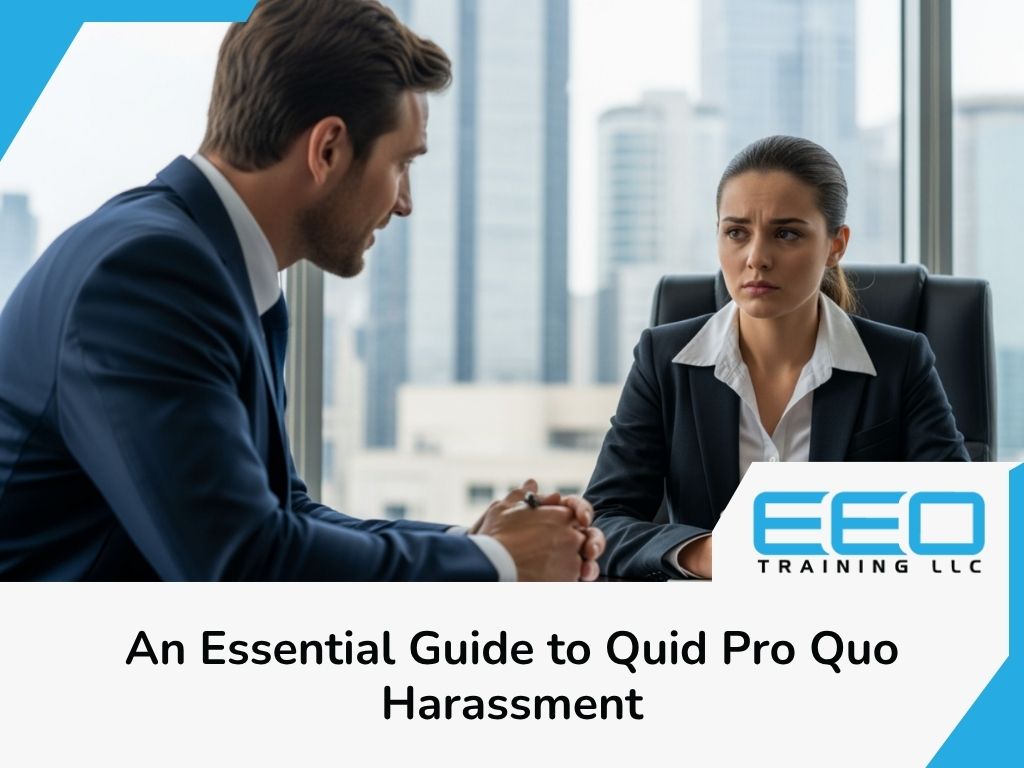
An Essential Guide to Quid Pro Quo Harassment
Understanding Quid Pro Quo Harassment
Quid pro quo harassment occurs when someone in a position of authority offers job benefits (like promotions or raises) in exchange for sexual favors, or threatens negative consequences (like demotion or termination) if those advances are refused.
Key Facts:
- Definition: “This for that” – employment decisions tied to unwelcome sexual conduct
- Who’s involved: An employee who is leveraging something over anyother employee in exchange for something
- Legal basis: Prohibited under Title VII of the Civil Rights Act of 1964
- Single incident: Unlike hostile work environment claims, one instance can be enough
- Employer liability: Companies are often automatically liable for supervisor actions
- Prevalence: According to a study, approximately 11% of New York employees reported experiencing quid pro quo harassment
For HR professionals and business leaders, understanding quid pro quo harassment means recognizing when workplace power is used to demand unwelcome conduct in exchange for job benefits or to avoid penalties.
This harassment exploits power dynamics, making employees feel they must comply with unwanted advances to protect their jobs or career aspirations. The law recognizes that this power imbalance makes true consent impossible, even if an employee seems to agree.
The consequences are severe. For employees who are victims and often those around the victims, it creates a toxic work environment and damages mental health. For employers, the financial and reputational costs are devastating, with defense costs averaging $100,000 to $150,000 per claim, not including settlements or court imposed damage awards.
Fortunately, quid pro quo harassment is preventable through clear policies, effective training, conscientious management, and a culture of respect.
The Legal Landscape of Quid Pro Quo Harassment

Quid pro quo harassment is rooted in federal and state anti-discrimination laws. Understanding its legal definition, characteristics, and distinction from other harassment types is crucial for both employees and employers.
Defining Quid Pro Quo Harassment and Its Key Elements
Quid pro quo, Latin for “this for that,” occurs when a person in a position of power over someone else links job benefits to sexual favors or negative job implications for failure to comply. The American Bar Association describes this as tying employment benefits to submitting to a supervisor’s unwelcome sexual advances.
To establish a claim, several key elements must be present:
- Unwelcome Sexual Advances or Conduct: The conduct must be unwelcome, meaning the employee found it undesirable and did not a solicit sexual advance. The key is whether the employee’s actions indicated the advances were unwelcome. As the EEOC’s Policy Guidance on Current Issues of Sexual Harassment notes, provocative speech or dress does not automatically mean a person invited harassment.
- Supervisor’s Authority: The harasser must have power (even if it is not traditional supervisory authority) over the victim, such as a supervisor or manager with power over hiring, firing, or promotions. This is a defining element of quid pro quo harassment.
- Tangible Employment Action: Employment benefits or consequences must be conditioned on the employee’s submission to or rejection of unwelcome conduct. This involves a “tangible employment action”—a significant change in employment status like hiring, firing, or demotion.
- The “Voluntary Submission” Myth: A common myth is that an employee’s “voluntary” submission negates a harassment claim. As covered in our Sexual Harassment Training, the law focuses on whether the conduct was unwelcome, not voluntary. The power imbalance can compel an employee to comply, in essence making the submission involuntary.
Under federal law, quid pro quo harassment is prohibited by Title VII of the Civil Rights Act of 1964, enforced by the EEOC. Many states, like California and New York, have laws that offer even broader protections, sometimes with a lower standard of proof.
Common Examples and How It Differs from a Hostile Work Environment
Common quid pro quo scenarios include:
- The “Promotion for a Date” Scenario: A supervisor tells an employee, “If you go out with me, I’ll make sure you get that promotion.”
- The “Threat of Demotion” Scenario: A manager implies that an employee’s job security depends on their compliance with inappropriate requests.
- Negative Performance Reviews/Denied Opportunities: An employee refuses a supervisor’s sexual advances and subsequently receives an unfairly negative performance review or is denied a promotion.
- Job Applicant Coercion: A hiring manager implies that hiring an applicant depends on them accepting sexual advances.

It’s important to distinguish quid pro quo from a hostile work environment. As we cover in our Sexual Harassment Training, which we cover by state, for example in California, they have distinct features crucial for a proper response.
| Feature | Quid Pro Quo Harassment | Hostile Work Environment Harassment |
|---|---|---|
| Harasser’s Role | Always a supervisor or someone with direct power or authority over the victim’s employment. | Can be a supervisor, coworker, client, vendor, or anyone in the workplace. |
| Nature of Conduct | Involves a direct demand or offer of sexual favors in exchange for employment benefits or to avoid negative consequences. | Involves unwelcome conduct (sexual or non-sexual, but based on sex) that is severe or pervasive (varies from jurisdiction). |
| Tangible Employment Action | Requires a change in employment status (e.g., hiring, firing, promotion, demotion) resulting from the refusal or submission to advances. | Does not necessarily involve a tangible employment action, but creates an intimidating, offensive, or abusive work environment. |
| Frequency/Severity | A single incident can be sufficient if it results in a tangible employment action. | Typically requires a pattern of severe or pervasive conduct (unless a single incident is sufficiently severe, like a sexual assault). |
| Focus | “This for that” — a direct exchange or threat. | Overall atmosphere and its impact on an employee’s ability to do their job. |
A single quid pro quo act can be illegal, whereas a hostile work environment typically requires a pattern of severe or pervasive behavior. A refused quid pro quo demand followed by ongoing offensive conduct can also create a hostile work environment.
Legal Protections and Remedies for Victims
Victims of quid pro quo harassment have robust legal protections and remedies available to compensate for harm and prevent future incidents.
Federal Law: Title VII of the Civil Rights Act of 1964 is the primary federal law prohibiting sexual harassment, enforced by the EEOC.
State Laws: Many states such as New York, like those covered in our Sexual Harassment Training, have laws offering broader protections than federal law, sometimes with lower proof thresholds or longer statutes of limitations.
Potential Remedies for Victims: Successful claims may entitle victims to various remedies for victims of sexual harassment, including:
- Compensatory Damages: Covers back pay, front pay, and compensation for emotional distress.
- Punitive Damages: Awarded in cases of malicious conduct to punish the employer and deter future harassment.
- Reinstatement/Promotion: The victim may be reinstated to their job or given the promotion they were denied.
- Injunctive Relief: Court orders requiring the employer to take preventative actions, like implementing policies or training.
- Attorney’s Fees and Costs: The employer may be ordered to pay the victim’s legal fees.
To seek justice, employees often must file a complaint with a state agency or the U.S. Equal Employment Opportunity Commission. The deadline is typically 180 days from the incident (though may vary in some states and jurisdictions). Missing this critical deadline can jeopardize a claim.
Responding to Harassment and Creating a Safer Workplace

At EEO Training, we believe preventing quid pro quo harassment is a shared responsibility requiring proactive measures from employers and a clear understanding of rights from employees.
Steps for Employees Experiencing Quid Pro Quo Harassment
If you are experiencing quid pro quo harassment, knowing what steps to take can empower you to seek justice.
- Document Everything: Create a detailed record of each incident: date, time, location, what was said and done, your reaction, and any witnesses. Minor details can be crucial.
- Save Evidence: Save all evidence, such as emails, texts, voicemails, or performance reviews that changed after you refused advances. Keep personal copies outside of work systems.
- Internal Reporting: Use your employer’s official channels to report the harassment to HR or a manager (unless they are the harasser). Report in writing and keep a copy to document that the company was notified.
- External Reporting: If internal reporting fails or you fear retaliation, file a complaint with the EEOC or a state agency. Be mindful of the typical 180/300-day filing deadline. You can check your EEOC claim status here.
- Seek Legal Counsel: The legal process is complex. An employment law attorney can explain your rights, evaluate your case, and represent you. We advise you to contact an attorney in your area. Our Sexual Harassment Training Florida resources can also offer guidance.
Retaliation for reporting harassment is illegal. If you face negative consequences after filing a complaint, contact an attorney immediately.
Employer Responsibilities in Prevention and Response
Employers have a significant legal and moral responsibility to prevent and address quid pro quo harassment. They are often strictly liable for harassment by supervisors, even if unaware, because supervisors act on the company’s behalf.
Here’s what employers must do:
- Develop Clear Anti-Harassment Policies: Create and distribute a clear policy that defines harassment, gives examples, outlines reporting procedures, and prohibits retaliation. Review and update it regularly.
- Establish Effective Complaint Procedures: Provide multiple, confidential reporting channels (e.g., HR, anonymous hotline) so employees can report harassment without fear. Ensure complaints are taken seriously and never require reporting to the offending supervisor.
- Conduct Regular, Interactive Training: Regular training is essential. Our programs, like Anti-Discrimination and Harassment Training, educate employees on identifying and reporting harassment. Managers require specialized training on their legal duties and how to handle complaints.
- Conduct Prompt and Impartial Investigations: Once a complaint is made, conduct a prompt, thorough, and impartial investigation, maintaining confidentiality as much as possible.
- Take Immediate Corrective Action: If harassment occurred, take immediate corrective action to stop it and prevent recurrence. Actions can range from counseling to termination of the harasser.
- Prevent Retaliation: Protect employees from retaliation for reporting harassment or participating in an investigation, as it is illegal.
Building a Respectful Workplace Culture
Beyond legal compliance, the best defense against harassment is a culture of respect, fairness, and open communication where all employees feel safe and valued.

- Leadership Commitment: Culture starts at the top. Leaders must model respectful behavior and consistently reinforce anti-harassment policies to set the tone for the organization.
- Ongoing Education: Prevention requires ongoing education. Our programs, like Sexual Harassment Training Requirements All 50 States, keep employees informed of their rights and responsibilities.
- Fostering Open Communication: Foster an environment where employees feel safe to speak up. Encourage feedback and ensure communication channels are open and accessible.
- Empowering Employees through Bystander Intervention: Bystander Intervention Training empowers employees to recognize and safely intervene in problematic situations, creating a collective responsibility that can prevent harassment from escalating.
By implementing these strategies, employers can foster a workplace where quid pro quo harassment is not only addressed—but actively prevented through a culture of accountability and respect. This approach protects employees, reduces risk, and strengthens the overall integrity of your organization. Strengthen your workplace culture and stay compliant— contact us today to learn how our training solutions can support your team.
